21 May 2025
Sodium-ion: The Three Big Promises of Sodium-Ion Batteries
Sodium-ion batteries offer a promising alternative to lithium-ion, with advantages in mineral abundance, system compatibility, and safety. They provide a cost-effective, scalable solution with lower material costs and reduced supply chain risks. Despite lower energy density, sodium-ion cells benefit from existing manufacturing infrastructure. Safety benefits include reduced fire risks and enhanced thermal stability. Key strategies for success include improving energy densities, competing on total cost of ownership, and targeting niche performance areas such as low temperature and high-power applications.

29 Apr 2025
Sodium-ion: The Battery Built for Trade Resilience
In a world where energy security increasingly intertwines with national security, the global battery supply chain has become a critical focal point of international tensions. As trade barriers rise and geopolitical rivalries intensify, sodium-ion battery technology emerges as a strategic alternative that promises greater self-reliance and reduced vulnerability to global supply chain disruptions.

22 Apr 2025
US Tariffs' Impact on the EV Charging Market
This article analyzes the significant impact of recent US tariffs on the EV charging market, affecting both the physical charging equipment and the broader electrical infrastructure required to support it.

02 Apr 2025
Sodium-ion Batteries - Key Takeaways and Killer Applications
In the first of this new series, IDTechEx Senior Technology Analyst Shazan Siddiqi caught up with Darren Tan, CEO of UNIGRID Battery, at Cambridge EnerTech's International Battery Seminar 2025 in Orlando, to discuss the evolving battery landscape.

25 Mar 2025
Sodium-ion Could Be The Next Step In Battery Technology
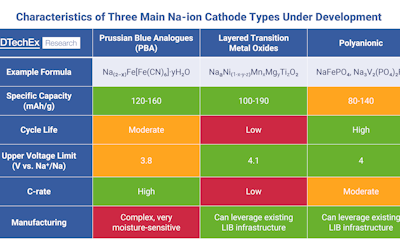
Sodium-ion batteries share similar electrochemical principles with lithium-ion but differ in cathodes, anodes, and electrolytes, with ongoing development in cost-effective sodium-based alternatives. While sodium-ion technology faces challenges in achieving cost-competitiveness with lithium-ion, advancements in engineering and material innovation could enable it to serve as a complementary solution in specific applications.

28 Jan 2025
Opportunities & Outlook for Electric Vehicle Charging Technologies
As electric vehicles (EVs) become the norm, charging infrastructure must adapt to meet the diverse needs of drivers everywhere. In this short video, IDTechEx Senior Technology Analyst Shazan Siddiqi breaks down the key charging technologies shaping the future.
23 Dec 2024
Trends Driving EV Charging Modules
A power module in DC fast chargers is a critical component that converts AC grid power into high-voltage DC power to charge EV batteries efficiently. It integrates rectifiers, inverters, and control systems to ensure precise power delivery while optimizing energy efficiency and minimizing heat loss. Power modules are essential for achieving rapid charging speeds and supporting high-power applications, meeting the demands of growing EV adoption.

12 Nov 2024
Bidirectional EVs Will Become Grid Assets
As electric vehicles (EVs) continue to reshape the automotive landscape, the integration of Vehicle-to-Grid (V2G) technology offers transformative potential for both the energy grid and vehicle owners.

07 Oct 2024
IDTechEx Takes a Look at the Key Trends Shaping the EV Charging Market
As EV adoption grows, stakeholders across automotive, energy, and technology sectors are in search of detailed insights to shape their strategies and investments.

27 Jun 2024
Vertical Ventures: Understanding eVTOL Operations
First came the eVTOL hype, followed by startups, investments, prototypes, and vertiport planning. Now, designs are being refined, and type certification is progressing. Battery and hydrogen fuel cell R&D are at their peak. eVTOL pilot training plans are forming, and vertiport construction is starting worldwide.

14 May 2024
What to Expect From the eVTOL Market in 2024 and Beyond
The inception of Urban Air Mobility (UAM) dates back to 2016 when Uber introduced their Elevate conference. The company that changed ground transportation triggered a huge wave of investment by supporting the future of Advanced Air Mobility. More than 300 new electric vertical take-off and landing (eVTOL) aircraft manufacturing start-ups were established over the course of the following few years, each grabbing a piece of the US$8.5 billion in funding that has been poured into the industry as of the end of 2023.

09 May 2024
Sodium-Ion Insights: Industry's Key Queries
Sodium-ion batteries are beginning to become increasingly relevant in 2024 after many mass production announcements were made in 2023. OEMs may look to alternative chemistries to reduce reliance on critical minerals with potentially volatile supply chains. NMC(A) batteries are currently the leading battery chemistry in Europe and the UK, while LFP dominates in China.

18 Apr 2024
Current Affairs: The Trends Shaping EV Charging Technology
There is undoubtedly a huge push to build global DC fast-charging networks. The US government is providing more than $5 billion in funding and incentives as part of the NEVI program to build a coast-to-coast fast charging network, and many countries in Europe are rolling out similar programs following the AFIR regulations to spur EV charging infrastructure growth. 2024 will be a big year for EV charging, but, as IDTechEx discuss in this article, there's more to the story.

02 Apr 2024
Taxiing For Takeoff: The Promise of eVTOLs
Flying cars are very easy to hype. Most images of the future almost always include mass mobility in the air. It is one of the staples of any depiction of advanced modern societies and a trope of almost every science fiction movie or book (however dystopian). It is an exciting time where the level of technological advancement is reaching the stage of making electric vertical take-off and landing (eVTOL) aircraft a feasible reality.

26 Feb 2024
Fueling the Future: Charging Infrastructure for Next-Gen Trucks
Global efforts to decarbonize medium- and heavy-duty (MHD) freight vehicles are crucial for reducing transportation-related greenhouse gas (GHG) emissions. These vehicles, pivotal to economies worldwide, emit significant GHGs and criteria pollutants, often impacting vulnerable communities.
12 Feb 2024
Sodium to Debut in Small Microcars First for Mobility Applications
Many people were surprised when HiNa revealed their lineup of sodium-ion battery cells, as well as a prototype of an electric car, in February 2023. But it had been a long time coming. The low-cost Sehol E10X microcar uses a 25 kWh battery pack made from cylindrical sodium-ion cells from HiNa.
12 Jan 2024
Electric Truck Milestones in 2023 and Outlook
Major fleets have committed to transitioning at least 30% of their new heavy-duty truck purchases to be zero-emission vehicles, including electric models, by 2030. However, many companies are daunted by the extra upfront cost of electric trucks, as well as challenges like the limited availability of chargers.
10 Jan 2024
Sodium-Ion Batteries Will Diversify the Energy Storage Industry
Sodium-ion (Na-ion) batteries are being developed due to their potential costs, safety, sustainability, and performance characteristics over traditional lithium-ion batteries. These batteries can be made with widely available and inexpensive materials, with sodium being significantly more abundant than lithium.
05 Dec 2023
Zero-Emission Truck Market Gains Momentum
The vast majority of new trucks produced today are powered by diesel engines, but this is expected to change, as with other on-road vehicle sectors. The magnitude of greenhouse gas emission reductions required to reach national targets necessitates a total decarbonization of the truck business over the next 30 years. This will only be possible if zero-emission powertrains are widely deployed.
24 Nov 2023
Evolution of the Automotive Industry and Electrification Beyond Cars
2023 has proven another momentous year for the electric vehicle (EV) market. 2022 saw electric car sales rise by 62% compared with 2021, and IDTechEx estimates that 2023 will see global sales rise by another 16%. But what can we expect for the future of EVs? In this article, Dr James Edmondson and Shazan Siddiqi from IDTechEx discuss what can be learned about the future of electrification, not only for vehicles on land, but also for marine sectors and aerial vehicles.
12 Oct 2023
Megawatt Charging Could Outshine Hydrogen in Semis
A new high-power charging solution is required to meet the market need of the truck and bus industry to charge electric heavy-duty vehicles in an acceptable amount of time. As a result, the Megawatt Charging System (MCS), a charging system for large battery electric vehicles, is now being developed.
07 Sep 2023
Three Key Trends Driving the EV Charging Market
The world is witnessing an electrifying revolution in the automotive industry. Electric vehicles (EVs) have emerged as a compelling solution to combat climate change and reduce our carbon footprint. As more and more individuals and businesses shift towards electric mobility, the demand for efficient and accessible EV charging infrastructure has skyrocketed.
14 Jul 2023
Cheaper and Safer Sodium-Ion Batteries on the Horizon
As the world progresses rapidly towards electrification, the energy storage industry is increasingly reliant on critical raw materials such as lithium and cobalt. Diversification of battery chemistries is critical for long-term capacity growth.
26 Jun 2023
EV Market Demands Reliable, Widely Available Charging Infrastructure
During the past few years, the global electric vehicle (EV) industry has experienced tremendous growth. Total global electric vehicle sales went from approximately 3.1 million in 2020 to over 9 million in 2022.
31 May 2023
Why Na-Ion Attraction Lies in Composition Rather Than Performance
Na-ion is probably the most prominent metal-ion battery chemistry outside of Li-ion, working via the same 'rocking chair' (where the alkali-ion shuttles from a non-metal anode to a cathode during discharge and vice versa during charge) principle of reversible cation intercalation, at a positive and negative electrode.
24 Apr 2023
Sodium-Ion Batteries: From Research to Commercialization
Among the existing energy storage technologies, lithium-ion batteries (LIBs) have unmatched energy density and versatility. Since their first commercialization, the growth in LIBs has been driven by portable devices. In recent years, however, large-scale electric vehicles and stationary applications have emerged
06 Apr 2023
Electric Scooters to Continue Skyrocketing in Popularity
Asia accounts for more than 90% of all global two-wheeler sales, and it is unusual for a family not to own one in some countries. The three largest markets ranked by annual sales are China, India, and Southeast Asia.
24 Feb 2023
Microcars Are the Smaller, Greener Future of Urban Commuting
There is a need to scrap the "highway-centric" model of urban development and prioritize the ease and convenience of local trips. Most car trips are short trips carrying just one person. Most of the energy is wasted on carrying the vehicle's own weight.
10 Feb 2023
Electric Vehicles: Wireless Charging Is Safer Than Plugging In
The most common method of Wireless Power Transfer (WPT) used today is accomplished via low to high-frequency (30 kHz to 30 MHz) time-varying magnetic fields. This may also be referred to as 'inductive WPT' or 'magnetic field WPT'.
13 Jan 2023
Micro EVS: Neither Fast nor Far
While there is no standardized definition of micro EVs, it is generally used to describe small vehicles that can seamlessly navigate highly populated urban areas. Micro EVs are designed for short trips of only a few kilometers and travel at low speeds, typically under 80 kilometers per hour (with various regional exceptions). These vehicles do not rely on internal combustion engines, and many are powered by electric motors.
30 Nov 2022
Wireless Opportunity Charging for Buses Key for Uptime and Revenue
Charging electric buses has so far been done overnight in depots. However, if the daily operating range of the bus exceeds the real-world range that the driver is able to achieve, then local transit authorities are often left with two options.
24 Oct 2022
Wireless Charging to Pull the Plug on Charging Stations
The development of wireless charging systems for electric vehicles (EVs) has slowly picked up momentum over the past decade. This charging solution relies on the principle of resonant inductive coupling to achieve wireless power transfer (WPT) from a ground-based pad to a vehicle-fitted pad. Drivers should simply align their vehicles with the ground pad for charging to begin automatically, eliminating the need to plug in.
02 Sep 2022
Battery Swapping Beginning to Show Unique Capabilities
IDTechEx believes that Europe will remain a charging dominant region with a focus on DC fast charging deployment, and the number of swapping stations will remain small.
06 Jul 2022
Battery Swapping: From Two-Wheelers to Trucks
The conductive fast-charging system as we know it today has drawbacks such as long dwell times, high power demand from the grid, availability and reliability issues, and the need for end-users to deal with heavy cables, dirty connectors, and buggy user interfaces. Battery-swapping is an emerging technology that aims to address all of these shortcomings.
25 May 2022
Battery Swapping to Compliment Inadequate Charging Infrastructure
Traditional cable-based charging of electric vehicles (EVs) is now being complemented by another solution: battery swapping. Various swap-enabled vehicles across different segments are now entering the market.
23 Mar 2022
Not So Fast: EV Charging Rates Make a Difference
Charging speeds for electric vehicles (EVs) vary, from as little as 15 minutes using an ultra-rapid 350 kW charger, to as much as 24 hours when relying on a domestic wall outlet. Eventually, we could reach a point where recharging barely takes longer than filling up with fuel.


