Biomanufacturing Specialty Chemicals: More Efficient and Sustainable
2026年3月10天
Dr Felix Wei

Industrial biomanufacturing occupies a distinctive position in the production of high-value specialty chemicals. This article discusses two of the technology trends in specialty chemical biomanufacturing, the use of cell-free systems and alternative non-sugar feedstocks.
While industrial biomanufacturing still represents a minority of total chemical tonnage, it already underpins entire categories of high-value specialty chemicals. Today, approximately 100% of industrial enzymes are produced via biomanufacturing. Unlike bulk commodities, specialty chemicals are high-value, performance-critical, and often produced at smaller scales where innovation can outpace infrastructure lock-in. By harnessing biological precision to build complex molecules with less energy and renewable inputs, biomanufacturing is uniquely powerful. Innovations in synthetic biology tools are expected to provide further strategic advantage in this sector.
Industrial biomanufacturing, or white biotechnology, utilizes biological processes to produce materials and chemicals for applications in various industries. IDTechEx's report, "Biomanufacturing Specialty Chemicals 2026-2036: Technologies, Markets, Players, Forecasts", presents detailed 10-year forecasts segmented by molecules and applications, covering major chemicals in terms of production capacity. The report offers detailed analysis of the market drivers, competitive landscape, and technology trends in biomanufacturing specialty chemicals, offering clear insights into the emerging opportunities and challenges shaping the industry.
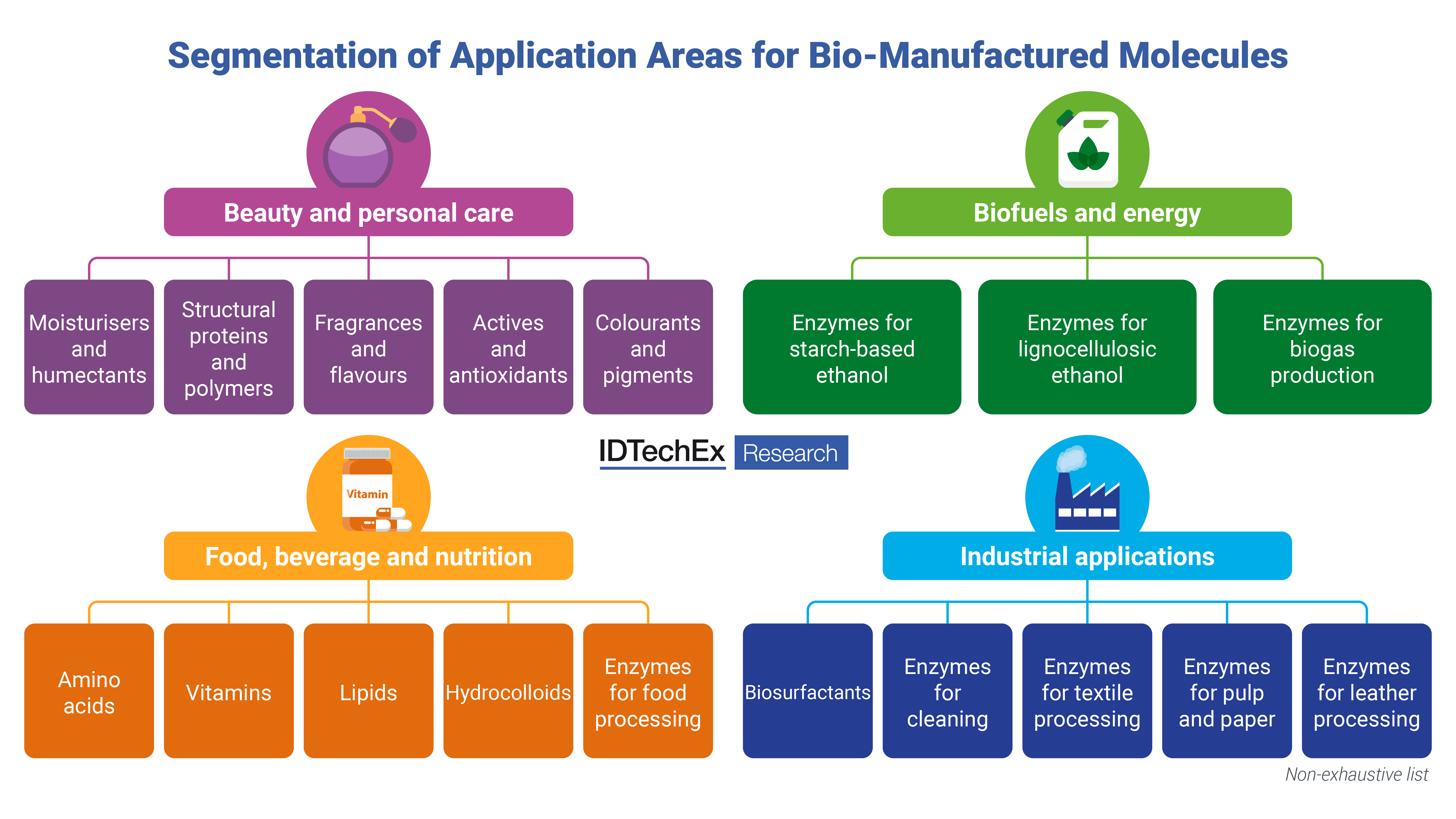
Source: IDTechEx "Biomanufacturing Specialty Chemicals 2026-2036: Technologies, Markets, Players, Forecasts".
Specialty chemical biomanufacturing is entering a pivotal phase, driven by advances in synthetic biology and the urgent demand for more sustainable production. Among the most transformative developments are the rise of cell-free systems and the shift towards alternative feedstocks. Cell-free platforms decouple biological synthesis pathways from the constraints of living cells, enabling higher tolerance to toxicity and more precise control over reaction conditions. In parallel, the move beyond sugar-based feedstocks towards various waste streams could redefine the economic and environmental impact of biomanufacturing.
Cell-free platforms could enable higher yield
Conventional industrial biomanufacturing relies on microbial fermentation, where the desired final product is produced either inside the cell of microorganisms (e.g. vitamins) or secreted outside the cell (e.g. antibiotics). While it is an established method, production often needs strict control of culture conditions and feedstock selection to ensure the viability of the microbes. Recent advances in cell-free systems attempt to break free of these constraints, and bring the yield, precision, and product diversity of biomanufacturing to a new level.
Cell-free biomanufacturing uses cell lysates (crude extracts containing the cell's entire internal machinery) or complex "cocktails" of many enzymes to mimic full cellular processes to synthesize molecules from scratch. This is not to be confused with enzymic manufacturing, which uses one or a few enzymes to perform a specific conversion. Since there are no living microbes, the reaction can take place at arbitrary or even unphysiological conditions, enabling the production of high concentrations of substances that might be toxic to or impossible for a living cell to make. For example, Debut Biotechnology has developed a cell-free platform to allow high yield production of polyphenols, an antioxidant, bypassing the toxicity problem to yeast cells.
Alternative feedstocks may reduce carbon footprint
Sugar-containing agricultural products, such as corn and sugarcane, are the most used feedstocks for industrial biomanufacturing. These are associated with growing concerns over competition with food and biofuel production. The biomanufacturing industry is progressively exploring alternative feedstocks such as agricultural by-products and gaseous waste streams. The move to these waste feedstocks could further reduce the carbon footprint and cost of white biotechnology and potentially increase productivity.
Notable alternative feedstocks include C1, C2 (referring to the number of carbon atoms in a molecule) and lignocellulosic biomass. For instance, C1 feedstocks, including methane, CO2, CO, methanol, and formate, are highly abundant industrial waste gases. To illustrate, in the US, there is an estimated 490 billion cubic feet of methane generated per year from natural gas venting, waste decomposition and wastewater treatment. Naturally occurring or engineered bacteria strains can convert them into useful chemicals via fermentation. However, these waste streams tend to be highly dispersed. Challenges such as costly transportation, special fermentation infrastructure, and lower yield compared to sugar-based feedstock need to be addressed for successful commercialization.
Outlook for biomanufacturing specialty chemical
While the specialty chemical biomanufacturing market will continue to be dominated by molecules that can exclusively be produced via white biotechnology, such as vitamins and enzymes, the growing need for sustainability across the value chain will command a two-fold transition in the industry. First, although microbial fermentation will remain the main production route, start-ups and incumbent players will seek to increase the yield by exploring innovative fermentation techniques, strain optimization, and a wider selection of feedstocks, powered by synthetic biology tools. Second, biomanufacturing will increasingly supplant petroleum-based methods for chemicals that can be produced via both routes.
For more details on the market drivers, technology trends, company landscape, and market forecast, see the IDTechEx market report "Biomanufacturing Specialty Chemicals 2026-2036: Technologies, Markets, Players, Forecasts".
For more information on this report, including downloadable sample pages, please visit www.IDTechEx.com/BioSpecChem. For more information on IDTechEx's other reports and market intelligence offerings, including bioplastics and biofuels, please visit www.IDTechEx.com/Research.
IDTechEx guides your strategic business decisions through its Research, Subscription and Consultancy products, helping you profit from emerging technologies. For more information, contact research@IDTechEx.com or visit www.IDTechEx.com.