This report has been updated. Click here to view latest edition.
If you have previously purchased the archived report below then please use the download links on the right to download the files.
Future Powertrains 2016-2036
Land vehicle powertrain design, component trends, markets, 48V MH, strong hybrid, pure electric, EIV
- Design for recyclability
- Disruptive new components
- New principles such as energy independence, autonomy
- Changes in law such as combatting global or local air pollution
- Government subsidies and tax breaks that can change suddenly
- Integration of mechanical, electrical and electronic parts - simpler with certain configurations and parts. For example components that move such as batteries swelling and shrinking and motors rotating are tough to integrate into structural materials as "structural electronics" - an important new discipline.
- Change in what is sought as with Porsche Engineering foreseeing a world of autonomous vehicles favouring pure electric powertrains but also commoditising the powertrain if vehicles are typically not bought by individuals any more but used on demand.
| 1. | EXECUTIVE SUMMARY AND CONCLUSIONS |
| 1.1. | Purpose and emphasis |
| 1.2. | Choice of powertrains is influenced by many factors |
| 1.3. | Future powertrain options in land vehicles |
| 1.4. | Where cars are headed in 2030 |
| 1.5. | Future powertrain options in land vehicles 2016-2036: the detail |
| 1.6. | Main influences in land vehicle powertrains |
| 1.6.1. | New focus for improvement and choice |
| 1.6.2. | New important powertrain options |
| 1.6.3. | Common enablers |
| 1.6.4. | Powertrain parameter priorities |
| 1.6.5. | Disruptive change |
| 1.6.6. | Summary of primary trends for the most important land vehicle powertrains 2016-2036 |
| 1.7. | Powertrain timeline 2016-2036 |
| 1.8. | Death of the strong hybrid that does not plug in? |
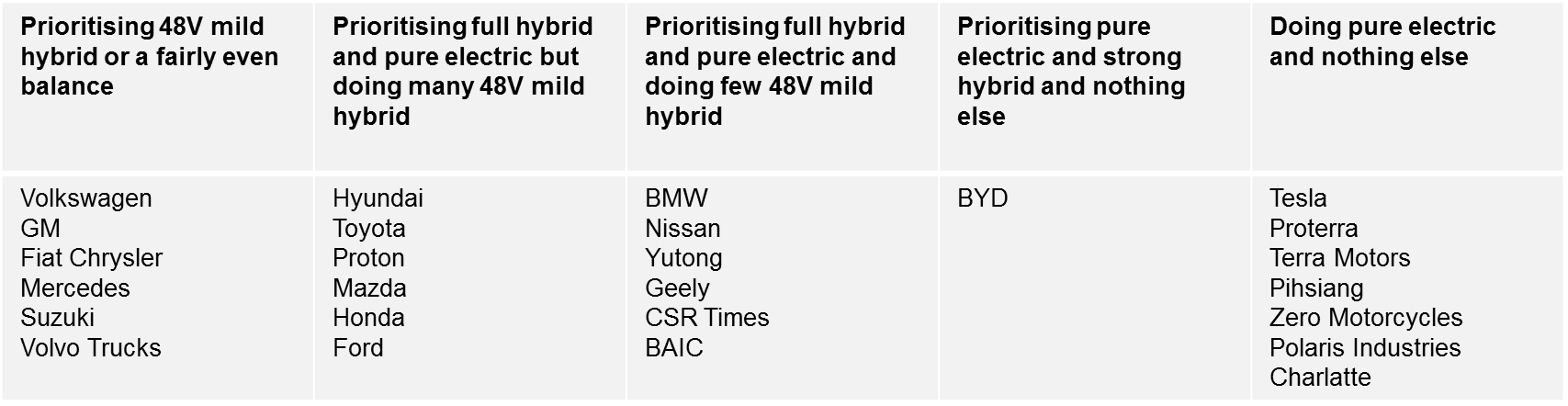
| 1.9. | Manufacturer priorities 2016-2030 |
| 1.10. | Increasing importance of power electronics: proliferation and enhancement |
| 1.11. | Structural electronics tears up the rule book |
| 1.12. | Market size 2016-2026 for electric vehicles and 48V mild hybrid cars (non-EV and EV form) |
| 2. | INTRODUCTION |
| 2.1. | What is a land vehicle powertrain? |
| 2.2. | Layout of the report |
| 2.3. | Entering the age of emissions control |
| 2.3.1. | Tightening regulations |
| 2.3.2. | Fuel options for greenhouse gas GHG control |
| 2.3.3. | ICE thermal efficiency improvement for emission reduction |
| 2.3.4. | Temperature control should get easier |
| 3. | TYPES OF POWERTRAIN |
| 3.1. | Pure electric or hybrid |
| 3.2. | Progression of vehicle powertrain electrification |
| 3.3. | Sequence of electrification of powertrains |
| 3.4. | Base solutions with performance variants |
| 3.5. | Many options opening up at component and system level |
| 3.6. | Small vs big vehicle electrification |
| 3.7. | Link with water and air vehicles |
| 3.8. | Influence of legislation - examples |
| 3.9. | Case study: Toyota Development of Power Control Unit for Compact-Size Vehicle |
| 4. | MILD HYBRID 48V: NEW LIFE FOR THE TRADITIONAL ICE |
| 4.1. | Mild hybrid history |
| 5. | STRONG HYBRID ELECTRIC POWERTRAINS |
| 5.1. | Strong "Full" Hybrid Electric Vehicles |
| 5.2. | Strong hybrid configurations |
| 5.2.1. | Plug in option |
| 5.3. | Comparison of storage and range extender options |
| 5.4. | Range extenders in context |
| 5.5. | Fuel cells for traction |
| 5.6. | Range extenders: not all about fuel cells! |
| 5.6.1. | Gas turbines and rotary combustion |
| 5.6.2. | Free piston engine range extenders |
| 6. | PURE ELECTRIC VEHICLE PEV |
| 6.1. | Powertrain |
| 6.1.1. | Architecture |
| 6.1.2. | Trend in number and position of traction motors. |
| 6.1.3. | Charging issues |
| 6.1.4. | Battery issues |
| 6.1.5. | Supercapacitor issues |
| 6.1.6. | Battery Management System |
| 6.2. | Wide adoption, small vehicles, buses, design issues |
| 6.3. | Cars and light commercial vehicles |
| 6.4. | Energy Independent Vehicles EIV |
| 6.4.1. | Why we want more than mechanical energy independence |
| 6.4.2. | Energy Independent Vehicles: definition and function |
| 6.4.3. | The EIV powertrain for land vehicles |
| 6.4.4. | EIV operational choices |
| 6.4.5. | Do not forget wind |
| 6.4.6. | Key EIV technologies |
| 6.4.7. | Stella Lux passenger car Netherlands |
| 6.4.8. | Sunswift eVe passenger car Australia |
| 6.4.9. | Resolution and EVA solar racers Cambridge University UK |
| 6.4.10. | Solar racer derivative: Immortus passenger car EIV Australia |
| 6.4.11. | POLYMODEL micro EV Italy |
| 6.4.12. | Venturi Eclectic passenger car Italy |
| 6.4.13. | Vinerobot micro EV France, Germany, Italy, Spain and Australia |
| 6.4.14. | Sold as Lizard EIV: NFH-H microbus China |
| 7. | SOME KEY EV POWERTRAIN DEVICES OF GENERAL USE |
| 7.1. | Introduction |
| 7.2. | Rotating electrical machines |
| 7.2.1. | One business land, water, air - hybrid and pure electric |
| 7.2.2. | Increase in number of rotating electrical machines per vehicle for traction |
| 7.2.3. | Trend to integration: transmission with electric motors |
| 7.2.4. | The main rotating machine options compared for traction |
| 7.2.5. | Reversible rotating machines for 48V mild hybrids |
| 7.2.6. | Rotating machines for strong hybrids and pure electric |
| 7.2.7. | Trend to in-wheel motors |
| 7.2.8. | Flywheel KERS |
| 7.2.9. | Flybrid KERS used by Wrightbus UK on hybrid buses |
| 7.2.10. | Volvo trial of mechanical flywheel KERS mechanical |
| 7.2.11. | Supplier view of mechanical flywheel KERS |
| 7.3. | Energy Storage |
| 7.3.1. | Options |
| 7.4. | Energy Storage Beyond Batteries |
| 7.4.1. | Overview |
| 7.4.2. | Operational principles: supercapacitors to batteries |
| 7.4.3. | Supercapacitors are often used across lithium-ion batteries |
| 7.4.4. | Possible future |
| 7.5. | Batteries |
| 7.6. | New forms of energy harvesting including regeneration |
| 7.6.1. | Overview |
| 7.6.2. | Complementarity of multiple harvesting |
| 7.6.3. | Example: regenerative suspension |
| 7.7. | Heavily downsized engines for primary power |
| 7.7.1. | Potential and approach |
| 7.7.2. | Mahle priorities |
| 7.7.3. | Compensating for performance reduction |
| 7.7.4. | Results |
| 7.8. | Lightweight multifunctional materials "structural electronics" |
| 7.8.1. | Objectives |
| 7.8.2. | Design problems resulting |
| 7.9. | Increasing importance of power electronics |
| 7.10. | Interview with Professor Pietro Perlo 26 April 2016 |
| 7.11. | Wrap up: everything is changing |

Report Statistics
| Slides | 203 |
|---|---|
| Forecasts to | 2026 |
Customer Testimonial
