Finding the Best Batteries for Electric Off-Highway Machines
2026314
Pranav Jaswani

As the off-highway industries of construction, agriculture, and mining begin to see greater electrification of machines, battery technologies will be critical to their performance and overall market adoption. This article highlights how the performance demands of machines can be understood in order to match them with the best-fitting battery technology.
The off-highway markets of construction, agriculture, and mining are in the midst of a significant push towards electrification, with governments, operators, and machine manufacturers (including the largest global OEMs such as Caterpillar, John Deere, and Volvo) increasingly aligned in their objectives. However, battery technologies, and specifically finding the best fit technologies for a given machine, will be critical in enabling successful electrification and widespread market adoption. IDTechEx's newly updated "Batteries for Construction, Agriculture, & Mining Machines 2026-2036: Technologies, Players, Forecasts" report details the key factors that will influence battery design and selection, allowing for optimized machine performance and development, and facilitating the growth of the off-highway battery market to over 45 GWh by 2036.
Why are electric off-highway machines being developed?
With greater impetus on decarbonization and sustainability across global sectors, the off-highway markets of construction, agriculture, and mining are witnessing greater interest and investment into electrification. Electric machines can eliminate local greenhouse gas emissions, resulting in a cleaner and safer workplace that also benefits from less heat, noise, and vibration.
Critically, electric machines also take on far lower OPEX by using electricity instead of diesel. This helps to provide more favorable total cost of ownership (TCO) for machines while protecting against the risk of diesel price volatility. As an added benefit, electric machines are easier to operate, less costly to maintain, and do not use up any energy while idling or stationary, offering additional operational advantages on top of the environmental and financial advantages.
Different off-highway machines have different requirements
For an electric off-highway machine to be used in place of a diesel machine, it must meet the same performance requirements in terms of its runtime and intensity of application. The wide variety of machines used in construction, agriculture, and mining each have different applications and operational profiles, creating a need for diversity in their batteries. Ultimately, the size of the batteries installed will depend on the machine's operating weight, desired runtime, and specific duty requirements during operation.
The mining industry makes use of machines that weigh hundreds of tonnes, often carrying loads that are equally as heavy. These machines are required to work nearly around the clock with very little downtime available for refueling or recharging. This has led to the use of some of the largest batteries in off-highway machines today, recently reaching as high as 2 MWh. This sits in stark contrast to the construction and agriculture markets, where machines are generally much smaller and only need to run for up to 8 hours a day, with batteries as small as 10 kWh being used in compact machines that weigh 6 tonnes or less.
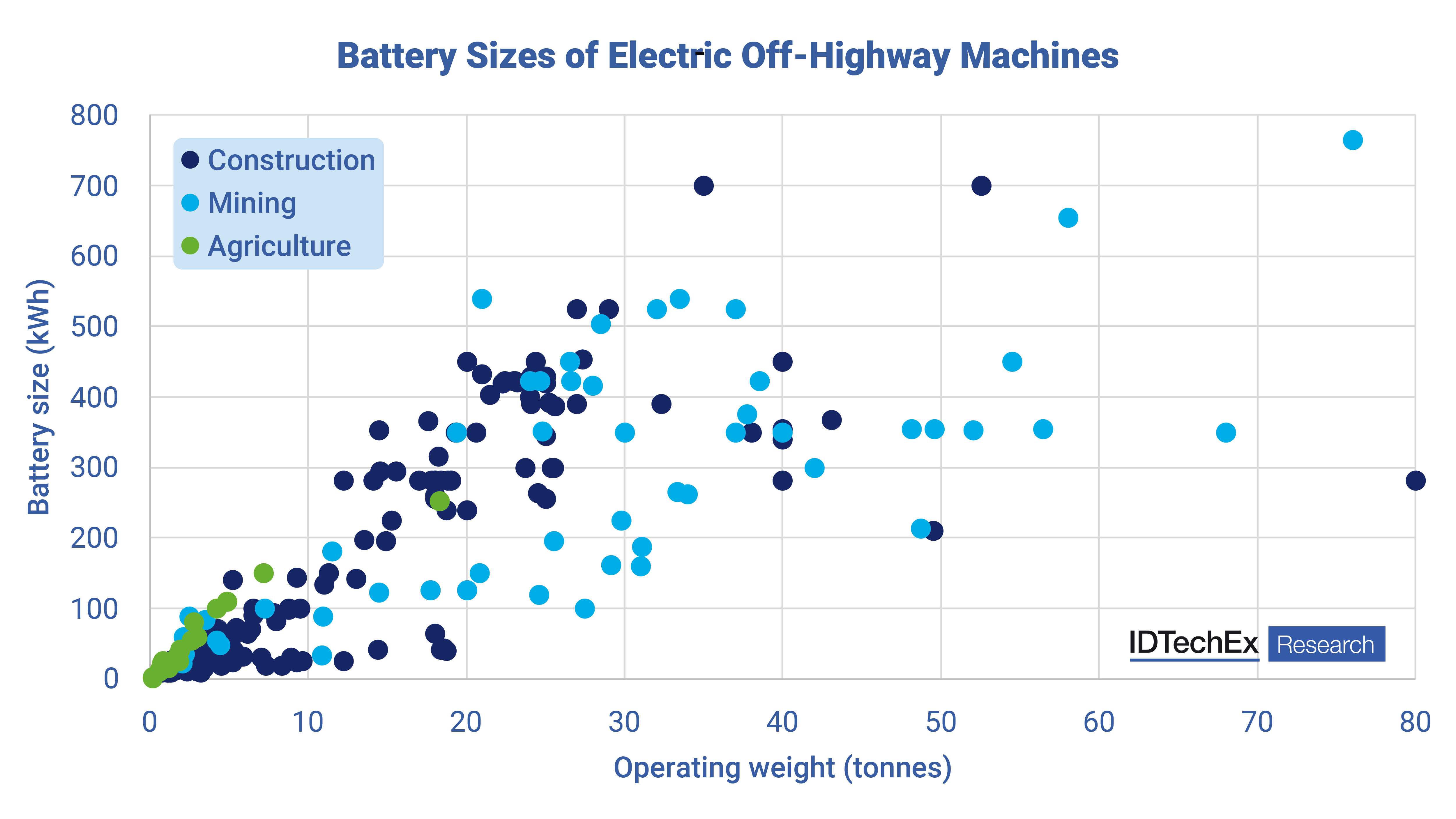
The operating weight of an electric machine is a key factor in determining the battery size it requires. Source: IDTechEx
Finding the right battery for an off-highway machine
Beyond battery capacity alone, a machine's operational requirements will place certain demands on the density, voltage, charging performance, lifetime, and cost that its battery must provide. The eventual battery technology used (which could be NMC, LFP, or an emerging battery chemistry) must find the right balance between these criteria in order to facilitate successful electrification.
Some operational requirements are specific to a given industry. For instance, not only do mining machines need to work nearly 24/7 but they must also operate in all weather conditions. Hence, batteries for these machines will require long cycle lives for constant use, very fast charging rates to minimize downtime, and excellent low-temperature performance. Meanwhile, agriculture machines need to drag heavy tools and implements over large areas, necessitating batteries with high power density.
However, IDTechEx's new report finds that the size of a machine will also play a key role in determining what batteries a machine uses by influencing the trade-offs between cost and energy density. Smaller machines are more constrained in the volume available for a battery, thus requiring high energy density batteries which can provide sufficient capacity and runtime while fitting in the machine's small form factor. On the other hand, larger machines are less constrained by size or weight. Instead, due to their need for larger battery capacities, a low cost per kWh battery is preferred to help minimize total machine costs, even if that comes at the expense of energy density.
IDTechEx's market outlook
IDTechEx's "Batteries for Construction, Agriculture, & Mining Machines 2026-2036: Technologies, Players, Forecasts" report goes into further detail on all the above factors and more, highlighting how the global market for off-highway batteries is set to grow to 45 GWh by 2036. This will be driven not only by the environmental, financial, and operational benefits that electric machines can provide, but also by the development of battery technologies, which will allow the performance needs of machines to be met.
The IDTechEx report breaks down the state of electrification in each industry, providing analyses of the technical, economic, and performance requirements of machines, benchmarking of turnkey battery products currently on the market, and an in-depth overview of key battery technologies and their relevance to off-highway applications. Granular 10-year forecasts are provided for global off-highway battery demand (in GWh) and battery revenue (in US$ billion) - segmented by off-highway segment (construction, agriculture, mining), machine type, region (US, China, Europe, Rest of the World), and battery technology (NMC, LFP, LTO, silicon anode, solid-state, and Na-ion).
For more information on this report, including downloadable sample pages, please visit www.IDTechEx.com/CAMBatteries, or for the full portfolio of battery research available from IDTechEx, see www.IDTechEx.com/Research/ES.