随着全球对饮用水中PFAS监管力度的持续增强,发掘PFAS处理技术的机遇变得愈发重要。本报告深入剖析了当前及新兴的PFAS清除技术,以及新兴与成熟的PFAS销毁技术的技术与商业成熟度。同时,本报告还探讨了PFAS处理技术在关键应用领域,如饮用水处理、AFFF(水成膜泡沫灭火剂)、垃圾填埋场渗滤液等方面的应用情况,旨在凸显这一新兴的可持续市场所带来的机遇。
本报告提供了关于新兴和现有的PFAS处理技术的重要市场情报,内容包括:
• 全球PFAS污染概况
• 不同地区的PFAS处理法规和标准:美国、欧洲、澳大利亚、亚太地区等
• 现有PFAS去除技术回顾:颗粒活性炭(GAC)、离子交换树脂、反渗透(RO)
• 新兴PFAS去除技术回顾:泡沫分馏、臭氧分馏、高分子吸附剂、粘土吸附剂等
• 现有和新兴的PFAS销毁技术回顾:焚烧、超临界水氧化(SCWO)、水热碱性处理(HALT)、等离子体处理、电化学氧化、光催化、声解
• 讨论其他技术:固定化、土壤中的PFAS处理等
• 针对每种技术提供的关键参与者、技术成熟度、全面应用等讨论
- 关键应用领域的PFAS处理分析,关注法规压力和技术前景:饮用水处理、水成膜泡沫(AFFF)、垃圾填埋场渗滤液、工业工艺用水、工业废水、市政废水、PFAS污染地下水、PFAS污染地表水
- 公司简介,包括与关键参与者的访谈
- 2025-2035年PFAS处理市场预测,重点关注全球饮用水处理的支出并提供市场的区域见解
- 执行摘要与结论
- PFAS和PFAS修复简介
- 水中PFAS的法规环境
- 关键PFAS处理技术
• 现有的PFAS去除技术:颗粒活性炭(GAC)、离子交换树脂、反渗透(RO)
• 新兴的PFAS去除技术:泡沫分馏、臭氧分馏、高分子吸附剂、粘土吸附剂等
• 现有和新兴的PFAS销毁技术:焚烧、超临界水氧化(SCWO)、水热碱性处理(HALT)、等离子体处理、电化学氧化、光催化、声解
• 其他技术:固定化、土壤中的PFAS处理等
- 关键PFAS处理应用:饮用水处理、水成膜泡沫(AFFF)、垃圾填埋场渗滤液等
- 公司简介,包括访谈
- 2025-2035年PFAS处理市场预测:全球饮用水处理支出及区域见解。
"Forever chemicals", the colloquial term for the family of chemicals known as PFAS, is coming under increasing regulatory pressure globally as concerns over the negative effects of PFAS on human health and the environment are mounting. In this new report, "PFAS Treatment 2025-2035: Technologies, Regulations, Players, Applications", IDTechEx examines the current and proposed regulations on PFAS contamination in several key regions to identify the need and opportunity for PFAS treatment technologies. This is accompanied by comprehensive assessment of incumbent and emerging PFAS treatment technologies. In this report, IDTechEx considers the drivers and challenges facing PFAS treatment in key areas, like drinking water treatment, to offer a market outlook on this developing field.
Introducing the "forever chemical" family - PFAS
PFAS stands for per- and polyfluoroalkyl substances and refers to synthetic chemical compounds that contain multiple fluorine atoms attached to an alkyl chain. The broad definition of PFAS by the Organization of Economic Cooperation and Development (OECD) encompasses nearly 5,000 unique chemicals, including PFOA (perfluorooctanoic acid), PFOS (perfluorooctane sulfonate) and PTFE (polytetrafluoroethylene).
Unsurprisingly, the applications of different PFAS chemicals are nearly as broad as the chemical family itself. Depending on the specific chemical, PFAS can confer helpful properties such as oil and water repellence, thermal stability, ionic conductivity, and more, making it applicable in many important application sectors including semiconductor manufacturing, healthcare, non-stick cookware, and firefighting foams.
Why are concerns over PFAS rising?
With so many PFAS and just as many applications for them, why are PFAS now coming under increased scrutiny? The colloquialism "forever chemicals" hints to a key issue for PFAS: its persistence in humans, wildlife, and the environment. Not only is PFAS persistent, but they can also be found in many environments, even isolated areas; as such, there is increased exposure to PFAS through a variety of sources. Now, scientific evidence is growing that, depending on different factors, continued exposure to specific PFAS may lead to negative health effects, such as increased risk of cancer, developmental delays, and hormonal issues (per the US Environmental Protection Agency (EPA) and the OECD).
Increasing global scrutiny on PFAS contamination in drinking water and the environment
PFAS has infiltrated the environment through numerous avenues: industrial discharge, usage of PFAS-containing firefighting foam (aqueous film forming foam (AFFF)), the leaching of PFAS-containing consumers goods, etc. Now, the sites of PFAS contamination around the world are just as numerous as the number of PFAS; one study estimated upwards of 57,000 sites of PFAS contamination in the United States alone. As such, human exposure to PFAS can occur in many ways. One of the most concerning is through drinking water, as PFAS has contaminated the groundwater and surface water sources supplying drinking water to millions across many countries.
In 2024, driven by concerns on the negative health effects of PFAS exposure, the US EPA instituted the lowest acceptable concentration levels for PFAS in the world: 4 ppt (parts per trillion) each for PFOA and PFOS, 10 ppt each for PFHxS, GenX, and PFNA, and additional Hazard Index that regulates mixtures of PFHxS, GenX, PFNA, and PFBS. The US is not the first to institute limits on PFAS in drinking water; several years ago, the European Union recast its Drinking Water Directive (DWD) to include limits on 20 individual PFAS. However, the US rules are the lowest PFAS limits in the world, potentially indicating the future trajectory of regulatory trends for environmental PFAS contamination. In its latest report, IDTechEx carefully considers the impact of adopted regulations and the potential influence of proposed regulations to provide a clear picture of the regulatory landscape on PFAS contamination.
Source: IDTechEx
Treating PFAS in the environment: a critical need and emerging opportunity
The scale of PFAS contamination and its threat to human health establishes a need to remove PFAS from the environment - PFAS remediation. It will require numerous treatment technologies to accomplish this, given the scale of PFAS contamination and its persistent nature. IDTechEx's new report extensively explores the technology landscape for PFAS treatment, appraising both incumbent and novel treatments to separate PFAS from the environment and permanently destroy it. This includes well-known technologies for water treatment, such as granular activated carbon and ion exchange resins, and emerging technologies like foam fractionation. The PFAS destruction technology landscape has received particular focus recently as key stakeholders, including regulators and the public, worry about the possibility of PFAS that was initially removed escaping back into the environment. IDTechEx highlights the most advanced emerging PFAS destruction technologies to examine their potential, considering factors like technology readiness level (TRL), active players, cost, and more.
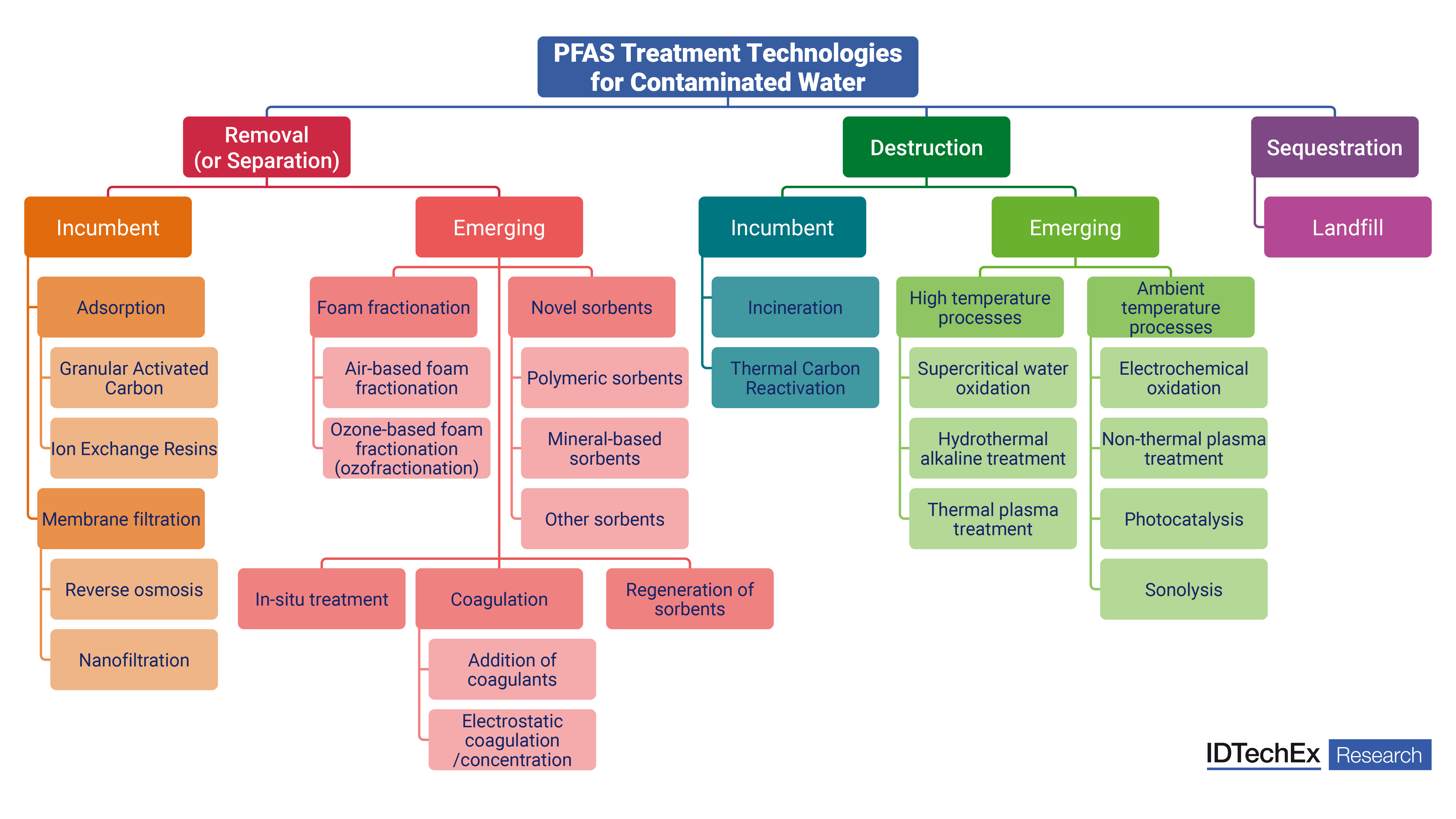
Source: IDTechEx
PFAS treatment applications emerging in response to PFAS regulations
With so many water streams and sites contaminated with PFAS, it will take broad adoption of PFAS treatment technologies to effectively remediate the environment of PFAS. Additionally, each site or water source requiring treatment will have unique circumstances, such as the initial level of PFAS contamination, presence of other contaminants, treatment objective, etc. that no single PFAS treatment can be universally applied. Different key areas requiring treatment, including municipal drinking water, aqueous film forming foam (AFFF), and industrial wastewater, will all have specific needs. Many combinations of PFAS removal and destruction technologies will be utilized to fully treat PFAS, so every technology may find its unique opportunity in this burgeoning market.
IDTechEx appraises each technology, both incumbent and emerging, to analyze its potential in the different application areas needing PFAS treatment. This is accompanied by player landscapes to establish the activity in each treatment area and technology. IDTechEx's comprehensive discussion and analysis will offer a clear picture of the dynamic PFAS treatment market for those looking to understand this rapidly emerging field in sustainability.
Key aspects
This report provides critical market intelligence about emerging and incumbent PFAS treatment technologies. This includes:
• Introduction to PFAS and PFAS Remediation
o Overview of global PFAS contamination
o Regulatory landscape and standards for PFAS treatment in different regions: US, Europe, Australia, Asia-Pacific, etc.
• Full technology analysis for key PFAS treatment technologies
o Review of incumbent PFAS Removal Technologies: Granular activated carbon (GAC), Ion exchange resins, Reverse osmosis (RO)
o Review of emerging PFAS removal technologies: foam fractionation, ozofractionation, polymeric sorbents, clay sorbents, etc.
o Review of incumbent and emerging PFAS Destruction Technologies: incineration, supercritical water oxidation (SCWO), hydrothermal alkaline treatment (HALT), plasma treatment, electrochemical oxidation, photocatalysis, sonolysis
o Other technologies discussed: immobilization, PFAS treatment of soil, etc.
o Discussion on key players, technology readiness level, full-scale applications, etc. for each technology provided
• Analysis of PFAS Treatment in key application sectors, looking at regulatory pressures and technology outlook: drinking water treatment, aqueous film-forming foam (AFFF), landfill leachate, industrial process water, industrial wastewater, municipal wastewater, PFAS contaminated groundwater, PFAS contaminated surface water
• Company profiles including interviews with key players
• PFAS treatment market forecast 2025-2035 that focuses on global expenditure of PFAS drinking water treatment and provides regional insights on the market


 EOY 2024 Webinar Slides
