This report has been updated. Click here to view latest edition.

If you have previously purchased the archived report below then please use the download links on the right to download the files.

2020-2030 年环境气体传感器

技术、生产商、预测
显示全部 说明 内容、图表列表 常见问题解答 价格 Related Content
该报告详尽地介绍了未来十年将用于监测室内和室外空气质量的关键技术。在整个会议期间,将提供一系列细分市场的十年预测,并分析关键趋势和未满足的需求。IDTechEx 预计,几个新市场的销售额将大幅增长,主要是在移动设备、空气净化器和可穿戴设备领域。
Poor air quality causes more deaths annually than HIV/AIDS and malaria combined. A lack of low-cost environmental monitoring equipment prevents individuals from taking action to improve air quality. Currently environmental monitoring methods are expensive and provide low spatial coverage, making their usefulness to individuals limited.
 
Sensors are based on tried and tested technology, new methods of manufacture are enabling smaller, lower power and more selective sensors. This has led to a tipping point in the industry, enabling the integration of sensors into low cost devices and into everyday consumer electronics such as mobile phones and wearable devices. In the future, a range of detection principles will be used to assess the wide range of pollutants in the environment.
 
At the same time, sensors will play a key role in IoT development and will be used extensively in smart home and smart city programmes. Heating, ventilation and air conditioning (HVAC) systems, air purifiers, smart windows and other applications will employ sensors to improve the quality of life of individuals across the world. We expect a growing market for gas sensors used in smart homes and smart cities.
 
In this report, we forecast the market for environmental gas sensors from 2020 to 2030. The atmospheric pollutants under examination include CO2, volatile organic compounds, NOx, Ammonia, SO2 and CO. Many pollutants exist at similar concentrations in the region of parts per billion (ppb). Consequently, there is a greater need for selective sensors in environmental monitoring. Another focus is the particle pollutant of micron size, as the concern of smog is growing.
 
This report covers gas sensors based on techniques of:
• Pellistor gas sensor
• Infrared (IR) gas sensor
• Metal oxide semiconductor (MOS) gas sensor
• Electrochemical (EC) gas sensor
• Optical particle monitor (OPM) gas sensor
• Photoionization detectors (PID)
• Field Asymmetric Ion Mobility Spectrometry (FAIMS)
• Quartz crystal microbalance (QCM)
• And miniaturised gas chromatograph (GC)
 
 
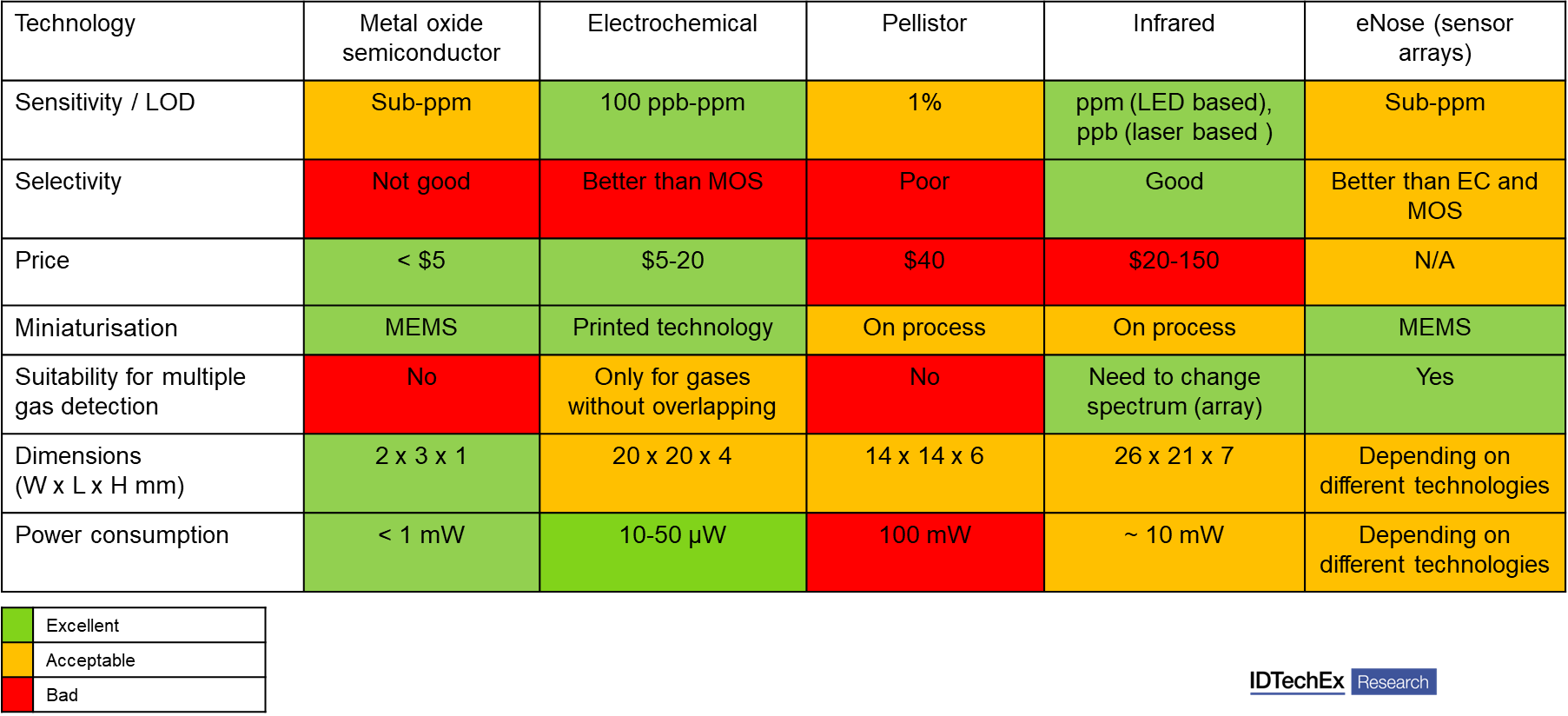
These techniques were compared with the traditional methods such as ultraviolet adsorption or filter dynamics measurement system. Gas sensors present an opportunity to attain good spatial coverage on environmental information, unobtainable with traditional monitoring methods. Microelectromechanical systems and screen-printing techniques open the door to miniaturising these sensors, which is the key for the future use of these gas sensors
 
The market forecast is based on six major market segments:
• automotive
• air purifier
• smart devices (mobile)
• smart home
• smart city
• and wearables.
 
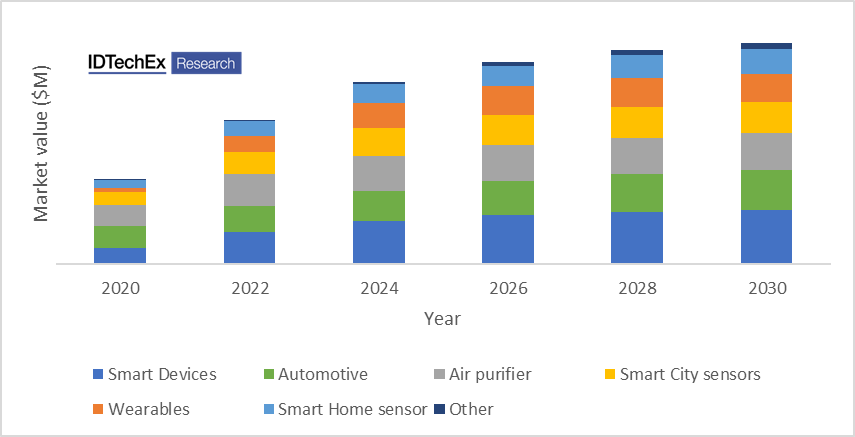
The environmental sensor market is currently dominated by the automotive industry, where sensors are used to automate air flow into the driver's compartment. Over the coming years, IDTechEx expect to see large increases in sales across several new markets, primarily to the mobile device and air purifier industries.
 
We provide a comprehensive study on current available devices that use gas sensors to monitor environment, including sensors in mobile devices, wearables, air purifiers, automobiles, smart cities, and to measure indoor air quality.
从 IDTechEx 访问分析师
所有报告购买订单均包括与一名专家分析师进行 30 分钟的电话交谈,专家分析师将帮助您将报告中的重要发现与您正在处理的业务问题联系起来。这需要在购买报告后的三个月内使用。
更多信息
如果您对这一报告有任何疑问,请随时联系我们的报告团队 research@IDTechEx.com 或致电我们的销售经理:

AMERICAS (USA): +1 617 577 7890
ASIA (Japan and Korea): +81 3 3216 7209
EUROPE (UK) +44 1223 812300
1.EXECUTIVE SUMMARY
1.1.New technology is unlocking the market
1.2.Comparison of miniaturised sensor technologies
1.3.Trends by detection principles
1.4.The gas sensor value chain
1.5.Key players in each sensor type
1.6.List of gas sensor manufacturers
1.7.Major market segments
2.INTRODUCTION
2.1.The global challenge of air pollution
2.2.Effects of outdoor air pollution
2.3.Indoor air pollution is also an issue
2.4.The seven most common atmospheric pollutants
2.5.International air quality standards
2.6.Need for environmental monitoring
2.7.Types of environmental sampling
2.8.Potential uses for low cost air quality monitors
3.MINIATURIZED GAS SENSORS FOR POLLUTION SENSING
3.1.Current pollution monitoring instruments are costly
3.2.Gas sensors offer an alternative
3.3.Sensor industry
3.4.History of chemical sensors
3.5.Concentrations of detectable atmospheric pollutants
3.6.Environmental sensing in industrial facilities
3.7.Sensitivity for main available gas sensors
3.8.Transition to miniaturised gas sensors
3.9.Sensor fabrication using MEMS manufacturing
3.10.Comparison between classic and miniaturised sensors (1)
3.11.Comparison of miniaturised sensor technologies
3.12.Pellistor gas sensors
3.13.Miniaturisation of pellistor gas sensors
3.14.Metal oxide semiconductors (MOS) gas sensors
3.15.N-type vs. p-type MOS gas sensors
3.16.MOS advancements and drawbacks
3.17.Methods to improve the specificity of MOS sensors
3.18.Miniaturisation Of MOS Gas Sensors
3.19.Suppliers for MOS sensors
3.20.BOSCH Sensortec MOS sensors
3.21.Alphasense MOS sensors
3.22.AMS MOS sensors
3.23.Alternative MOS sensors: conducting polymer‐based gas sensors
3.24.Electrochemical (EC) gas sensors
3.25.Specificity of EC sensors
3.26.Flat electrochemical sensors
3.27.Miniaturisation of electrochemical gas sensors
3.28.Suppliers for Electrochemical sensors
3.29.Infrared gas sensors
3.30.Sensitivity, selectivity and interference of IR gas sensors
3.31.Light source and detector
3.32.list of common gases that are detected by IR gas sensors
3.33.Laser suppliers for gas sensing (1)
3.34.Laser suppliers for gas sensing (2)
3.35.Suppliers for IR gas sensors
3.36.Senseair IR gas sensors
3.37.Redfinch project: prototype of micro IR gas sensor
3.38.Mirsense: multiSense
3.39.THzDC
3.40.Electronic nose (e-Nose)
3.41.Algorithms and software to solve the multiple gas detection
3.42.Alpha Szenszor Inc.
3.43.Airsense: PEN3 portable electronic nose
3.44.UST triplesensor-the artificial nose
3.45.Sensigent: Cyranose Electronic Nose
3.46.Aryballe
3.47.Some of the commercial eNose
3.48.Photoionization detectors (PID)
3.49.PID lamps
3.50.Suppliers for PID sensors
3.51.Other technology: Ion Mobility Spectrometry (IMS)
3.52.Other technology: Field Asymmetric Ion Mobility Spectrometry (FAIMS)
3.53.Other technology: Miniaturised GC
3.54.Other technology: Quartz crystal microbalance (QCM)
3.55.Current research in gas sensors: carbon nanotubes
3.56.Current research in gas sensors: zeolites
3.57.Current research in gas sensors: graphene
3.58.Energy harvesting technologies for gas sensors
3.59.Limitations of gas sensing devices
4.COMPETITIVE ANALYSIS OF THE ENVIRONMENTAL SENSOR MARKET
4.1.The gas sensor value chain
4.2.List of gas sensor manufacturers
4.3.Sensor manufacturer business models
4.4.Porters' five force analysis of industry
4.5.Quality assurance for environmental monitoring equipment
4.6.SWOT analysis of 10 manufacturers
4.7.Future challenges for sensor manufacturers
5.SENSORS IN MOBILE DEVICES
5.1.The mobile device industry
5.2.Suitable detection principles for mobile devices
5.3.Consumer interface for gas sensing data
5.4.Challenges for sensor integration into smartphones
5.5.Future market opportunities in the mobile device sector
6.SENSORS IN WEARABLES
6.1.The wearable technology industry
6.2.Sensor integration in wrist wear
6.3.Technology requirements of wearable sensors
6.4.NotAnotherOne
6.5.Wearable sensors as part of modular wrist straps
6.6.Environmental sensor integration in fashion accessories
6.7.H2S Professional Gas Detector watch
6.8.Future opportunities for wearable sensors
7.SENSORS TO MEASURE INDOOR AIR QUALITY
7.1.Indoor air quality
7.2.Sources of indoor air pollutants
7.3.Effects of CO2 exposure on decision making
7.4.Home and office monitoring: a connected environment
7.5.Current smart home monitoring vendors
7.6.Sensors to direct HVAC systems
7.7.HVAC systems in buildings
7.8.Future opportunities for IAQ monitoring
7.9.Challenges for indoor air quality measurement
8.SENSORS IN AIR PURIFIERS
8.1.The global air purifier market
8.2.Methods of air purification
8.3.Suitable miniaturised detection principles for air purifiers
8.4.Challenges in indoor air quality monitoring
9.SENSORS IN AUTOMOBILES
9.1.Automobile pollution: a global epidemic
9.2.Air quality sensors safeguarding passengers
9.3.Car mounted sensors monitoring air pollution in Mexico City
9.4.Challenges for automobile gas sensing
9.5.Future opportunities for automobile gas sensors
10.SENSORS IN SMART CITIES
10.1.Introduction to smart cities
10.2.Fixed vs mobile sensing networks
10.3.Personal vs private networks
10.4.Current city wide pollution monitoring programmes
10.5.Current smart city air monitoring projects
10.6.Calculated air quality measurements
10.7.Transport based sensing of environmental pollutants
10.8.Airborne pollution sensing
10.9.Mobile monitoring: sensors on bicycles
10.10.Traffic monitoring with gas sensors
10.11.Array of things project - Chicago
10.12.Anatomy of an outdoor sensor node
10.13.Challenges for smart city monitoring
10.14.Future opportunities for environmental sensors in smart cities
11.OTHER APPLICATIONS
11.1.Handheld environmental monitors
11.2.Aircasting
12.12. MARKET FORECASTS
12.1.Forecast details and assumptions
12.2.Breakdown by market segments
12.3.Market forecast: unit sales by market segments
12.4.Market forecast: market value by market segments
12.5.Unit sales forecast by Detection Principle
12.6.Market value Forecast by Detection Principle
12.7.Sensors in Smart Devices, by Volume
12.8.Sensors in Smart Devices, by Revenue
12.9.Sensors in Wearables, by Volume
12.10.Sensors in Wearables, by Revenue
12.11.Sensors in Air Purifier by Volume
12.12.Sensors in Air Purifier by Revenue
12.13.Sensors in Smart City by Volume
12.14.Sensors in Smart City by Revenue
12.15.Sensors in Smart Home by Volume
12.16.Sensors in Smart Home by Revenue
12.17.Sensors in Automotive by Volume
12.18.Sensors in Automotive by Revenue
12.19.Other applications, by volume
12.20.Other application, by Revenue
12.21.Conclusions
 

About IDTechEx reports

What are the qualifications of the people conducting IDTechEx research?

Content produced by IDTechEx is researched and written by our technical analysts, each with a PhD or master's degree in their specialist field, and all of whom are employees. All our analysts are well-connected in their fields, intensively covering their sectors, revealing hard-to-find information you can trust.

How does IDTechEx gather data for its reports?

By directly interviewing and profiling companies across the supply chain. IDTechEx analysts interview companies by engaging directly with senior management and technology development executives across the supply chain, leading to revealing insights that may otherwise be inaccessible.
 
Further, as a global team, we travel extensively to industry events and companies to conduct in-depth, face-to-face interviews. We also engage with industry associations and follow public company filings as secondary sources. We conduct patent analysis and track regulatory changes and incentives. We consistently build on our decades-long research of emerging technologies.
 
We assess emerging technologies against existing solutions, evaluate market demand and provide data-driven forecasts based on our models. This provides a clear, unbiased outlook on the future of each technology or industry that we cover.

What is your forecast methodology?

We take into account the following information and data points where relevant to create our forecasts:
  • Historic data, based on our own databases of products, companies' sales data, information from associations, company reports and validation of our prior market figures with companies in the industry.
  • Current and announced manufacturing capacities
  • Company production targets
  • Direct input from companies as we interview them as to their growth expectations, moderated by our analysts
  • Planned or active government incentives and regulations
  • Assessment of the capabilities and price of the technology based on our benchmarking over the forecast period, versus that of competitive solutions
  • Teardown data (e.g. to assess volume of materials used)
  • From a top-down view: the total addressable market
  • Forecasts can be based on an s-curve methodology where appropriate, taking into account the above factors
  • Key assumptions and discussion of what can impact the forecast are covered in the report.

How can I be confident about the quality of work in IDTechEx reports?

Based on our technical analysts and their research methodology, for over 25 years our work has regularly received superb feedback from our global clients. Our research business has grown year-on-year.
 
Recent customer feedback includes:
"It's my first go-to platform"
- Dr. Didi Xu, Head of Foresight - Future Technologies, Freudenberg Technology Innovation
 
"Their expertise allows us to make data-driven, strategic decisions and ensures we remain aligned with the latest trends and opportunities in the market."
- Ralf Hug, Global Head of Product Management & Marketing, Marquardt

What differentiates IDTechEx reports?

Our team of in-house technical analysts immerse themselves in industries over many years, building deep expertise and engaging directly with key industry players to uncover hard-to-find insights. We appraise technologies in the landscape of competitive solutions and then assess their market demand based on voice-of-the-customer feedback, all from an impartial point of view. This approach delivers exceptional value to our customers—providing high-quality independent content while saving customers time, resources, and money.

Why should we pick IDTechEx research over AI research?

A crucial value of IDTechEx research is that it provides information, assessments and forecasts based on interviews with key people in the industry, assessed by technical experts. AI is trained only on content publicly available on the web, which may not be reliable, in depth, nor contain the latest insights based on the experience of those actively involved in a technology or industry, despite the confident prose.

How can I justify the ROI of this report?

Consider the cost of the IDTechEx report versus the time and resources required to gather the same quality of insights yourself. IDTechEx analysts have built up an extensive contact network over many years; we invest in attending key events and interviewing companies around the world; and our analysts are trained in appraising technologies and markets.
 
Each report provides an independent, expert-led technical and market appraisal, giving you access to actionable information immediately, rather than you having to spend months or years on your own market research.

Can I speak to analysts about the report content?

All report purchases include up to 30 minutes of telephone time with an expert analyst who will help you link key findings in the report to the business issues you're addressing. This needs to be used within three months of purchasing the report.

What is the difference between a report and subscription?

A subscription from IDTechEx can include more reports, access to an online information platform with continuously updated information from our analysts, and access to analysts directly.

Before purchasing, I have some questions about the report, can I speak to someone?

Please email research@idtechex.com stating your location and we will quickly respond.

About IDTechEx

Who are IDTechEx's customers?

IDTechEx has served over 35,000 customers globally. These range from large corporations to ambitious start-ups, and from Governments to research centers. Our customers use our work to make informed decisions and save time and resources.

Where is IDTechEx established?

IDTechEx was established in 1999, and is headquartered in Cambridge, UK. Since then, the company has significantly expanded and operates globally, having served customers in over 80 countries. Subsidiary companies are based in the USA, Germany and Japan.

Questions about purchasing a report

How do I pay?

In most locations reports can be purchased by credit card, or else by direct bank payment.

How and when do I receive access to IDTechEx reports?

When paying successfully by credit card, reports can be accessed immediately. For new customers, when paying by bank transfer, reports will usually be released when the payment is received. Report access will be notified by email.

How do I assign additional users to the report?

Users can be assigned in the report ordering process, or at a later time by email.

Can I speak to someone about purchasing a report?

Please email research@idtechex.com stating your location and we will quickly respond.
 
到 2030 年,环境传感器的整体市场规模将达到 38 亿美元

报告统计信息

幻灯片 198
预测 2030
 

Customer Testimonial

quote graphic
"The resources provided by IDTechEx, such as their insightful reports and analysis, engaging webinars, and knowledgeable analysts, serve as valuable tools and information sources... Their expertise allows us to make data-driven, strategic decisions and ensures we remain aligned with the latest trends and opportunities in the market."
Global Head of Product Management and Marketing
Marquardt GmbH


Subscription Enquiry