전세계적으로 음용수에 대한 PFAS 규제가 강화됨에 따라 PFAS 처리기술을 통한 기회를 이해하는 것이 중요해지고 있습니다. 이 보고서에서는 PFAS 음용수 처리, 수성막포(AFFF), 매립지 침출수 등과 같은 분야에서 기존 및 새로운 PFAS 제거기술과 새롭게 부상하고 있는 PFAS 파괴기술의 기술 수준과 상업화 단계에 대한 평가, 시장기회 분석 및 향후 10년간 시장 예측 및 전망을 제공합니다.
이 보고서에서는 PFAS 관련 기존 기술과 새롭게 부상하고 있는 기술에 대해 아래와 같은 주요 정보를 제공합니다.
PFAS 개요 및 PFAS 정화
- 전 세계 PFAS 오염 개요
- 각 지역별 PFAS 처리 규제 환경 및 표준: 미국, 유럽, 호주, 아시아
주요 PFAS 처리 기술 분석
- 기존 PFAS 제거 기술 : 입상 활성탄(GAC), 이온 교환 수지, 역삼투압(RO)
- 새로운 PFAS 제거 기술 : 거품분리, 오조분리, 고분자 흡착제, 점토 흡착제 등
- 기존 및 새로운 PFAS 파괴 기술 : 소각, 초임계수산화(SCWO), 열수 알카리처리(HALT), 플라즈마 처리, 전기 화학적 산화, 광촉매, 초음파 분해 등
- 기타 기술: 고정화, 토양의 PFAS 처리 등
- 각 기술에 대한 주요 플레이어, 기술 준비단계, 상업화 응용분야 등 평가
주요 응용 분야의 PFAS 처리 분석, 규제 압력 및 기술 전망
주요 기업 프로필
지역별 시장예측 및 전망
이 보고서에서 다루는 주요 내용/목차는 아래와 같습니다.
1. 핵심 요약 및 결론
2. PFAS 개요 및 PFAS 정화
3. 물 관련 PFAS 규제 동향
4. PFAS 처리 기술
- 기존 PFAS 제거 기술 : 입상 할성탄(GAC), 이온 교환 수지, 역삼투압(RO)
- 새로운 PFAS 제거 기술 : 거품분리, 오조분리, 고분자 흡착, 점토 흡착 등
- 기존 및 새로운 PFAS 파괴 기술 : 소각, 초임계산화(SCWO), 열수 알카리처리(HALT), 플라즈마 처리, 전기 화학적 산화, 광촉매, 초음파 분해 등
- 기타 기술 : 고정화, 토양의 PFAS 처리 등
5. 주요 PFAS 처리 응용분야 : 식수 처리, 수성막포(AFFF), 매립지 침출수 등
6. 기업 프로필
7. 시장 예측 및 전망
"Forever chemicals", the colloquial term for the family of chemicals known as PFAS, is coming under increasing regulatory pressure globally as concerns over the negative effects of PFAS on human health and the environment are mounting. In this new report, "PFAS Treatment 2025-2035: Technologies, Regulations, Players, Applications", IDTechEx examines the current and proposed regulations on PFAS contamination in several key regions to identify the need and opportunity for PFAS treatment technologies. This is accompanied by comprehensive assessment of incumbent and emerging PFAS treatment technologies. In this report, IDTechEx considers the drivers and challenges facing PFAS treatment in key areas, like drinking water treatment, to offer a market outlook on this developing field.
Introducing the "forever chemical" family - PFAS
PFAS stands for per- and polyfluoroalkyl substances and refers to synthetic chemical compounds that contain multiple fluorine atoms attached to an alkyl chain. The broad definition of PFAS by the Organization of Economic Cooperation and Development (OECD) encompasses nearly 5,000 unique chemicals, including PFOA (perfluorooctanoic acid), PFOS (perfluorooctane sulfonate) and PTFE (polytetrafluoroethylene).
Unsurprisingly, the applications of different PFAS chemicals are nearly as broad as the chemical family itself. Depending on the specific chemical, PFAS can confer helpful properties such as oil and water repellence, thermal stability, ionic conductivity, and more, making it applicable in many important application sectors including semiconductor manufacturing, healthcare, non-stick cookware, and firefighting foams.
Why are concerns over PFAS rising?
With so many PFAS and just as many applications for them, why are PFAS now coming under increased scrutiny? The colloquialism "forever chemicals" hints to a key issue for PFAS: its persistence in humans, wildlife, and the environment. Not only is PFAS persistent, but they can also be found in many environments, even isolated areas; as such, there is increased exposure to PFAS through a variety of sources. Now, scientific evidence is growing that, depending on different factors, continued exposure to specific PFAS may lead to negative health effects, such as increased risk of cancer, developmental delays, and hormonal issues (per the US Environmental Protection Agency (EPA) and the OECD).
Increasing global scrutiny on PFAS contamination in drinking water and the environment
PFAS has infiltrated the environment through numerous avenues: industrial discharge, usage of PFAS-containing firefighting foam (aqueous film forming foam (AFFF)), the leaching of PFAS-containing consumers goods, etc. Now, the sites of PFAS contamination around the world are just as numerous as the number of PFAS; one study estimated upwards of 57,000 sites of PFAS contamination in the United States alone. As such, human exposure to PFAS can occur in many ways. One of the most concerning is through drinking water, as PFAS has contaminated the groundwater and surface water sources supplying drinking water to millions across many countries.
In 2024, driven by concerns on the negative health effects of PFAS exposure, the US EPA instituted the lowest acceptable concentration levels for PFAS in the world: 4 ppt (parts per trillion) each for PFOA and PFOS, 10 ppt each for PFHxS, GenX, and PFNA, and additional Hazard Index that regulates mixtures of PFHxS, GenX, PFNA, and PFBS. The US is not the first to institute limits on PFAS in drinking water; several years ago, the European Union recast its Drinking Water Directive (DWD) to include limits on 20 individual PFAS. However, the US rules are the lowest PFAS limits in the world, potentially indicating the future trajectory of regulatory trends for environmental PFAS contamination. In its latest report, IDTechEx carefully considers the impact of adopted regulations and the potential influence of proposed regulations to provide a clear picture of the regulatory landscape on PFAS contamination.
Source: IDTechEx
Treating PFAS in the environment: a critical need and emerging opportunity
The scale of PFAS contamination and its threat to human health establishes a need to remove PFAS from the environment - PFAS remediation. It will require numerous treatment technologies to accomplish this, given the scale of PFAS contamination and its persistent nature. IDTechEx's new report extensively explores the technology landscape for PFAS treatment, appraising both incumbent and novel treatments to separate PFAS from the environment and permanently destroy it. This includes well-known technologies for water treatment, such as granular activated carbon and ion exchange resins, and emerging technologies like foam fractionation. The PFAS destruction technology landscape has received particular focus recently as key stakeholders, including regulators and the public, worry about the possibility of PFAS that was initially removed escaping back into the environment. IDTechEx highlights the most advanced emerging PFAS destruction technologies to examine their potential, considering factors like technology readiness level (TRL), active players, cost, and more.
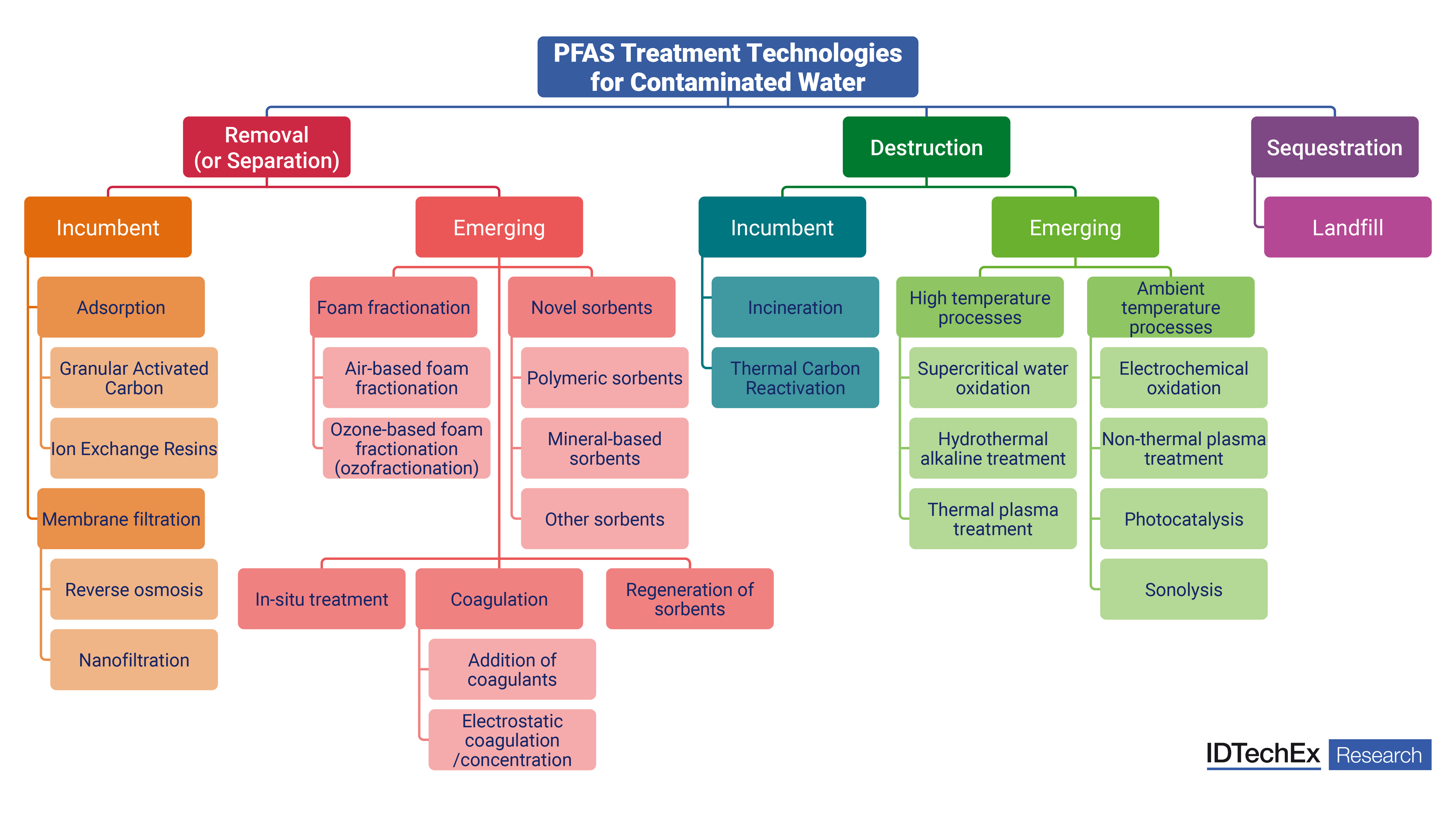
Source: IDTechEx
PFAS treatment applications emerging in response to PFAS regulations
With so many water streams and sites contaminated with PFAS, it will take broad adoption of PFAS treatment technologies to effectively remediate the environment of PFAS. Additionally, each site or water source requiring treatment will have unique circumstances, such as the initial level of PFAS contamination, presence of other contaminants, treatment objective, etc. that no single PFAS treatment can be universally applied. Different key areas requiring treatment, including municipal drinking water, aqueous film forming foam (AFFF), and industrial wastewater, will all have specific needs. Many combinations of PFAS removal and destruction technologies will be utilized to fully treat PFAS, so every technology may find its unique opportunity in this burgeoning market.
IDTechEx appraises each technology, both incumbent and emerging, to analyze its potential in the different application areas needing PFAS treatment. This is accompanied by player landscapes to establish the activity in each treatment area and technology. IDTechEx's comprehensive discussion and analysis will offer a clear picture of the dynamic PFAS treatment market for those looking to understand this rapidly emerging field in sustainability.
Key aspects
This report provides critical market intelligence about emerging and incumbent PFAS treatment technologies. This includes:
• Introduction to PFAS and PFAS Remediation
o Overview of global PFAS contamination
o Regulatory landscape and standards for PFAS treatment in different regions: US, Europe, Australia, Asia-Pacific, etc.
• Full technology analysis for key PFAS treatment technologies
o Review of incumbent PFAS Removal Technologies: Granular activated carbon (GAC), Ion exchange resins, Reverse osmosis (RO)
o Review of emerging PFAS removal technologies: foam fractionation, ozofractionation, polymeric sorbents, clay sorbents, etc.
o Review of incumbent and emerging PFAS Destruction Technologies: incineration, supercritical water oxidation (SCWO), hydrothermal alkaline treatment (HALT), plasma treatment, electrochemical oxidation, photocatalysis, sonolysis
o Other technologies discussed: immobilization, PFAS treatment of soil, etc.
o Discussion on key players, technology readiness level, full-scale applications, etc. for each technology provided
• Analysis of PFAS Treatment in key application sectors, looking at regulatory pressures and technology outlook: drinking water treatment, aqueous film-forming foam (AFFF), landfill leachate, industrial process water, industrial wastewater, municipal wastewater, PFAS contaminated groundwater, PFAS contaminated surface water
• Company profiles including interviews with key players
• PFAS treatment market forecast 2025-2035 that focuses on global expenditure of PFAS drinking water treatment and provides regional insights on the market


 EOY 2024 Webinar Slides
