
26 Nov 2026
Air Cooling Has Hit Its Limit, But What Exactly Is Taking Its Place?
As AI demand continues to push data center server racks to higher power ratings, air cooling has reached its limit. Direct-to-chip liquid cooling has become the default cooling architecture for top AI server racks such as NVIDIA's Vera Rubin architecture, forcing operators to quickly adopt the technology. As server racks continue to push to higher power ratings, perhaps exceeding 1MW through the next decade, emerging liquid cooling strategies, including immersion cooling and two-phase technologies, may quickly become necessary to keep up with evolving chip and rack architectures.

15 Oct 2026
What it Actually Takes to Get PFAS Out of Drinking Water
Around the world, laws are coming into effect limiting the legal concentration of PFAS in drinking water, and polluters are forking out billions of dollars to compensate for the effects of PFAS leaks. IDTechEx forecasts the annual spending on PFAS treatment for drinking water to reach US$3.45 billion by 2037. Established technologies like granular activated carbon and ion-exchange resins dominate the removal industry today, with emerging technologies like foam fractionation and polymeric sorbents offering distinct advantages. In destruction, opinions on incineration technology continue to fluctuate, while supercritical water oxidation and hydrothermal alkaline treatment continue to gain traction.

05 Oct 2026
The Evolving PFAS Regulatory Landscape: Video Overview
IDTechEx analyst Matthew Fall covers the regulatory landscape for PFAS, in addition to current and emerging treatment technologies.

24 Sep 2026
IDTechEx Expert Comment: Forever Chemicals Found in UK Residents Blood
It has been reported that residents near a chemical factory in Thornton-Cleveleys, Lancashire, UK have found elevated PFOA (Class I carcinogen) in their blood. PFOA is a type of PFAS, a group of synthetic chemicals known as "forever chemicals" due to their persistence in the environment and human body.

15 Sep 2026
Your ZIP Code, Your Passport, Your PFAS Fate: EU and US Regulations
The EU is in the process of drawing a red line through PFAS. In the USA, that line is red, blue, and constantly shifting. By the end of 2026, the final opinion of the European Chemical Agency's Socio-Economic Analysis Committee will be submitted. The European Commission will then propose laws to restrict the use of all PFAS across all industries, with certain applications receiving time-limited derogations if PFAS-free alternatives are not available. Across the Atlantic, the EPA, under the Trump administration, has committed to rolling back Biden-era maximum contaminant levels for some PFAS in drinking water, focusing instead on PFAS removal and destruction technology. IDTechEx expects global yearly spending on PFAS treatment for water, led by the USA, to reach US$3.45 billion by 2037. PFAS regulations in the USA vary significantly by state, with stark contrasts across party lines.

23 Jul 2026
Ban the Molecule or Manage the Risk? Technologies for Two Futures
The EU and the USA's different approaches to the PFAS problem have created diverging opportunities for innovation. In the EU, the threat of a sweeping ban on PFAS creates a drive for development of PFAS-free alternatives to materials used in critical industries such as semiconductor manufacture. The USA is instead focusing on PFAS treatment technologies, which include removal and destruction. IDTechEx expects global spending on PFAS treatment for drinking water (led largely by the USA) to exceed US$3.45 billion by 2037.

14 Jul 2026
Mind the (Band)gap! The Evolving Power Electronics Materials Landscape
Silicon, silicon carbide, gallium nitride, and ultra-wide bandgap (UWBG) semiconductors all compete for space in the power electronics market. While data centers drive further commercialization of wide bandgap semiconductors to support increasingly power-hungry servers, other industries such as wind energy are reluctant to switch to newer, less proven technologies. At the same time, UWBG R&D continues to push these materials closer to commercialization, further complicating the power electronics industry's future.

03 Jun 2026
How 800V EV Innovations are Redefining AI Data Centers
The transition to 800V in electric vehicles has accelerated the commercialization of wide bandgap semiconductors, and has led to increased vehicle range, faster charging, and greater e-powertrain efficiency. AI data centers are being pushed to ever-increasing power ratings to support future generations of AI training and inference. Drawing inspiration directly from EV power electronics, the data center industry is working to develop the HVDC (800VDC) data center, enabled by wide bandgap power electronics innovations.

05 May 2026
Outlook for Wide Bandgap Semiconductors: Explainer Video
In this brief video IDTechEx analyst Matthew Fall assesses Silicon Carbide (SiC) and Gallium Nitride (GaN) semiconductor materials, which are used for power electronics in data centers, renewables and electric vehicles.
21 Apr 2026
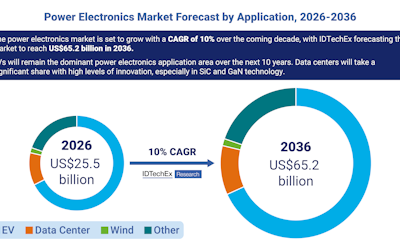
Power Electronics Market to Exceed US$65 billion by 2036
IDTechEx forecasts the power electronics market to exceed US$65 billion by 2036, with EVs and data center power electronics taking up significant market share. Across the power electronics industry, the commercialization of wide bandgap semiconductors SiC and GaN enable increased efficiency and power density. The demands of the EV, data center, and renewables industries differ significantly, resulting in different rates of technological innovation across the power electronics landscape. By understanding how different power electronics applications relate to each other, IDTechEx offers a unique, cross-application insight into the power electronics industry as a whole.


